Thursday, April 7, 2016

Celebrating more than 200 years of emergent patterns

and the hidden work of Sophie Germain
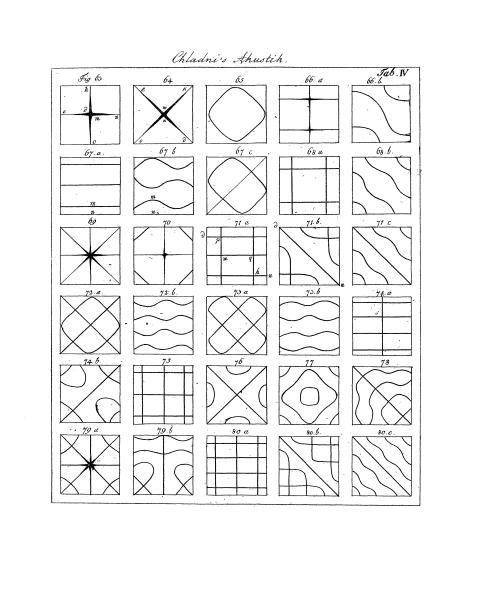


from "Die Akustik" by Ernst Chladni 
[image source: http://link.library.utoronto.ca/booksonline]

=> nothing phoolish about Fourier coefficients!

Recommended reading:
  • "From Euler, Ritz, and Galerkin to Modern Computing" By M. Gander and G. Wanner, SIAM Vol. 54, No. 4 (2012)
  • "Images of sound" by S.Morris and L. Sharman [http://www.physics.utoronto.ca/nonlinear/preprints/idea_s02_02-morris-sharman.pdf]

DLW


Tuesday, March 15, 2016

The death and rebirth of the stock exchange - FT.com


Good popular media article on the rapidly changing role of stock exchanges

March 9, 2016 5:58 pm, The death and rebirth of the stock exchange, John Gapper, The Financial Times.

1. " ... The best days of being a stock exchange are in the past, when they were near-monopolies owned by market-making members and could easily make money. ...",
2. “... The core business of matching buyers and sellers is not very profitable and does not have great prospects.” Being a stock exchange was fine while entry barriers were high and they could shield themselves from competition....",
3. "... If stock exchanges are so weak, why are the companies that own them so resilient? The answer is simple: [they are] not really [a] stock exchange[s] any more.".

However: "Networks remain powerful — exchanging contracts through a hub rather making a multitude of bilateral deals creates economies of scale." - until this is challenged.

Sunday, March 6, 2016

No such thing as a risk-neutral market - D L Wilcox

No such thing as a risk-neutral market

Authors: D.L.Wilcox
Abstract: A very brief history of relative valuation in neoclassical finance since 1973 is presented, with attention to core currency issues for emerging economies. Price formation is considered in the context of hierarchical causality, with discussion focussed on identifying mathematical modelling challenges for robust and transparent regulation of interactions.
Comments: 8 pages, 6 figures
Subjects: General Finance (q-fin.GN)
Cite as: arXiv:1602.08429 [q-fin.GN]
(or arXiv:1602.08429v1 [q-fin.GN] for this version)

Thursday, February 4, 2016

Before QuERILab (2004)

RESEARCH PROBLEM STATEMENT (2004)

It is common to consider financial markets as made up of stocks which can be grouped or clustered according to similar characteristics, for example some stocks offer low returns with respect to improvement in their value but pay high dividends, while others offer small dividends but increase in value relatively quickly. The understanding of grouping characteristics is important for understanding the overall dynamics of the market in which such clustering takes place. The appearance of grouping or clustering behaviour may be due to random effects (noise) since there are bound to be overlapping properties when the number of stocks is high. Hence it is necessary to investigate methods for measuring possible noise contributions to clustering. Furthermore, grouping may change over time so that it is necessary to identify the time horizons for which clusters are stable. Is it possible to identify sectors, groups of stocks which display similar behaviour with respect to returns, and states, time periods for which the market behaves similarly, in SA financial data, by purely quantitative methods under the constraint that noise and temporal stability are understood? 

Thuthuka grant:  TTK2004072200035 (Funded from 2004)

TEAM in 2004
  • DW = Diane Wilcox (applicant); 
  • TG = Tim Gebbie (co-investigator);
  • 1 Msc student [Project :Fourier Method for the Measurement of Univariate and Multivariate Volatility in the presence of High Frequency Data (graduated 2006)]
  • 1 Internal project proposal reviewer (UCT Dept Mathematics & Applied Mathematics)
  • 10 External reviewers (appointed by the NRF)
Other outputs by DW since 2004 are documented on http://www.dianewilcox.net/currresearch.htm


Monday, February 1, 2016

High-speed detection of emergent market clustering via an unsupervised parallel genetic algorithm


High-speed detection of emergent market clustering via an unsupervised parallel genetic algorithm

Type: Research Article
Authors: Dieter Hendricks  (contact author) Tim Gebbie Diane Wilcox
Issue: January/February 2016
Number of pages: 9
DOI: http://dx.doi.org/10.17159/sajs.2016/20140340
Published: 01 February 2016

Abstract:
We implement a master-slave parallel genetic algorithm with a bespoke log-likelihood fitness function to identify emergent clusters within price evolutions. We use graphics processing units (GPUs) to implement a parallel genetic algorithm and visualise the results using disjoint minimal spanning trees. We demonstrate that our GPU parallel genetic algorithm, implemented on a commercially available general purpose GPU, is able to recover stock clusters in sub-second speed, based on a subset of stocks in the South African market. This approach represents a pragmatic choice for low-cost, scalable parallel computing and is significantly faster than a prototype serial implementation in an optimised C-based fourth-generation programming language, although the results are not directly comparable because of compiler differences. Combined with fast online intraday correlation matrix estimation from high frequency data for cluster identification, the proposed implementation offers cost-effective, near-real-time risk assessment for financial practitioners.

Keywords:
unsupervised clustering; genetic algorithms; parallel algorithms; financial data processing; maximum likelihood clustering