Sunday, April 17, 2016

Demonstrating the high-performance low-latency stock market simulator developed by QuERI Lab


This is the website for the interface that uses the fully re-configurable high-performance low-latency matching engine developed by Dharmesh Sing for large-scale ABM modeling. This is being used for the following working paper which is based on the testing of the infrastructure as part of the graduate research project of Mr Sing:

The simulation of a realistic market data feed using mutually-exciting Hawkes processes
 D. SING, D. HENDRICKS , and T. GEBBIE

We propose a feasible scheme for the simulation of an asynchronous stream of limit order book events.
An n-variate mutually-exciting Hawkes process is used to govern the times of coupled liquidity demand
and supply events, while trade and quote prices and volumes are generated consistent with the event
type. This provides a flexible framework to simulate a market data feed with varying throughput, with
full control over the trade and quote conditional intensities.

Keywords: market microstructure; Hawkes process; data simulation; limit order books
JEL Classification: C61, C63, D81, G10

Wednesday, April 13, 2016

Reflections on risk, regulation and model revision

Pricing perspectives continue to come under scrutiny in 2016. Consider the following communications by leading researchers this year on FVA:


[Hull] Models and measures 1 & 2

http://www.fincad.com/blog/models-and-measures-1 (2 Feb 2016)
"Risk-neutral valuation is without doubt the most important single principle in derivative pricing. If we did not have risk-neutral valuation, we would have to make estimates of the return provided by underlying market variables in the real world and then quantify the riskiness of the payoff in some way to determine the correct discount rate."

http://www.fincad.com/blog/models-and-measures-2 (1 Mar 2016)
"But it should always be remembered that a risk-neutral world is nothing more than an artificial construct. It does not describe how market variables behave in the real world, the world we actually live in."


[Duffie] You're doing Swaps Account wrong (11 Mar 2016)

http://www.bloomberg.com/news/articles/2016-03-11/professor-to-wall-street-you-re-doing-swaps-accounting-wrong (11 Mar  2016)
"Nitpicking over a $500,000 cost on a $100 million trade might seem inconsequential, but the market for interest-rate swaps, the largest in the world, is $319 trillion in size, according to the Bank for International Settlements. Even small errors matter."

and here is Hull on the ongoing FVA debate:
http://www.riskmindslive.com/what-is-the-fva-debate/ (26 Nov 2015)
https://www.youtube.com/watch?v=meyVxzd-Khw


DLW

Thursday, April 7, 2016

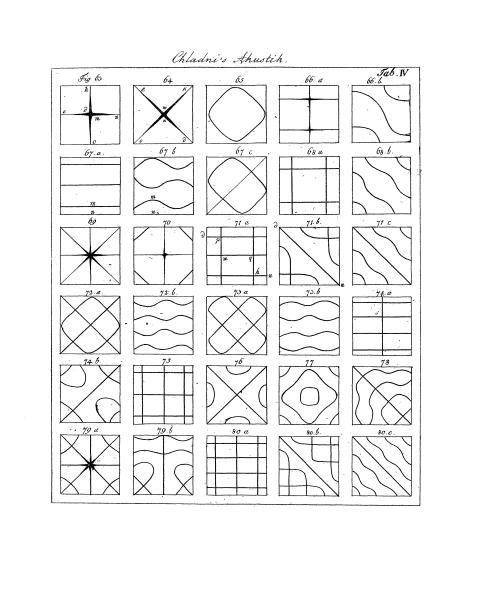
Celebrating more than 200 years of emergent patterns

and the hidden work of Sophie Germain


from "Die Akustik" by Ernst Chladni 
[image source: http://link.library.utoronto.ca/booksonline]

=> nothing phoolish about Fourier coefficients!

Recommended reading:
  • "From Euler, Ritz, and Galerkin to Modern Computing" By M. Gander and G. Wanner, SIAM Vol. 54, No. 4 (2012)
  • "Images of sound" by S.Morris and L. Sharman [http://www.physics.utoronto.ca/nonlinear/preprints/idea_s02_02-morris-sharman.pdf]

DLW


Tuesday, March 15, 2016

The death and rebirth of the stock exchange - FT.com


Good popular media article on the rapidly changing role of stock exchanges

March 9, 2016 5:58 pm, The death and rebirth of the stock exchange, John Gapper, The Financial Times.

1. " ... The best days of being a stock exchange are in the past, when they were near-monopolies owned by market-making members and could easily make money. ...",
2. “... The core business of matching buyers and sellers is not very profitable and does not have great prospects.” Being a stock exchange was fine while entry barriers were high and they could shield themselves from competition....",
3. "... If stock exchanges are so weak, why are the companies that own them so resilient? The answer is simple: [they are] not really [a] stock exchange[s] any more.".

However: "Networks remain powerful — exchanging contracts through a hub rather making a multitude of bilateral deals creates economies of scale." - until this is challenged.

Sunday, March 6, 2016

No such thing as a risk-neutral market - D L Wilcox

No such thing as a risk-neutral market

Authors: D.L.Wilcox
Abstract: A very brief history of relative valuation in neoclassical finance since 1973 is presented, with attention to core currency issues for emerging economies. Price formation is considered in the context of hierarchical causality, with discussion focussed on identifying mathematical modelling challenges for robust and transparent regulation of interactions.
Comments: 8 pages, 6 figures
Subjects: General Finance (q-fin.GN)
Cite as: arXiv:1602.08429 [q-fin.GN]
(or arXiv:1602.08429v1 [q-fin.GN] for this version)